
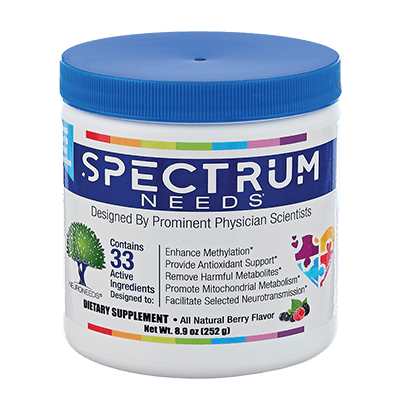

 What Is SpectrumNeeds®?
 What Is ActivNeeds?
 What Is EnergyNeeds®?
 What Is QNeeds®?
 What Is CalmNeeds®?
 What Is OmegaNeeds™?
 What Is FocusNeeds™?
 What is FolinicNeeds®?
 Products By Condition
 Blog
Blog About NeuroNeeds Video
 Products Guide
 Medical Advisory Committee
 Research
 Find A Doctor
ZINC
Zinc is a mineral that must be obtained in the diet and is required for life. Zinc is a cofactor necessary for the activity of about 100 enzymes, including those in energy metabolism, thyroid function, synapse formation, immune function, wound healing, and blood clotting. Zinc deficiency is both serious and common, especially occurring in individuals with poor nutrition and/or gastrointestinal disease. Neurodevelopmental disorders often are associated with an elevated excitatory-to-inhibitory neurotransmission balance, promoting increased excitatory behaviors (e.g., anxiety, loss of focus) and possibly regression. As zinc is an agonist for (turns on) GABA receptors, one of the chief inhibitory pathways in the nervous system, and an antagonist for (turns off) NMDA glutamate receptors, one of the chief excitatory pathways in the nervous system, zinc can help to re-normalize this balance. Zinc picolinate is a highly bioavailable form of zinc that is often recommended for anxiety and hyperactivity. As anxiety and hyperactivity are common side effects of leucovorin, zinc picolinate was added to FolinicNeeds® to prevent these effects. Side effects are rare at usual doses used in supplementation other than nausea, which is unlikely given the low dosing in FolinicNeeds®.
Zinc in FolinicNeeds®
Zinc is added to FolinicNeeds® because of its calming nature, in order to counteract the hyperactivity that is a common side effect with leucovorin. Side effects are unexpected at the doses used in FolinicNeeds®.
Zinc is a mineral that must be obtained in the diet and is required for life.
Zinc is a cofactor necessary for the activity of about 100 enzymes. Thus, zinc has wide-reaching effects in the body, including in energy metabolism, thyroid function, synapse formation, immune function, wound healing, and blood clotting.
Zinc deficiency is a serious and common problem worldwide, affecting over 2 billion people. In addition to a common problem in the developing world, zinc deficiency is not rare in developed countries, especially in individuals with poor nutrition and/or gastrointestinal disease. Zinc deficiency is often suspected due to disorders of the skin (eczema, seborrhea, acne, Impaired wound healing), nails (brittle), and hair (thin, sparse). Other features include mental or cognitive disorders (include attention and mood), sensory loss (including blunted taste), frequent infections, mouth sores, diarrhea, and loss of appetite.
Zinc is often recommended for a variety of health conditions including growth retardation, gastrointestinal conditions (acute diarrhea, ulcerative colitis, peptic ulcers), immunological conditions (frequent infections including the common cold, malaria, AIDS, asthma), eye diseases (macular degeneration, night blindness, cataracts), neurological disorders (Alzheimer, autism, ADHD, anorexia nervosa), dermatological conditions (psoriasis, eczema, acne, slow wound healing, hair loss), diabetes, and high blood pressure. Some athletes use zinc for improving athletic performance and strength.
Zinc is an agonist for (turns on) for GABA receptors, one of the chief inhibitory pathways in the nervous system, whereas under stimulation may lead to increased hyperactive behaviors in some individuals. Zinc is also an antagonist for (turns off) NMDA glutamate receptors, one of the chief excitatory pathways in the nervous system, which may play a role in neuroprotection and thus potentially guard against episodes of neurological regression. There is evidence of abnormal inhibitory–excitatory balance in the brain of individuals with some brain disorders, which may be targeted by therapy via effects on GABA and glutamate neurotransmission.
Studies performed to date, the clinical experience of many expert physicians, and the generally benign nature of zinc supplementation, have convinced some experts to offer zinc supplementation to their patients with a wide variety of disease manifestations. Individuals that are more likely to benefit are those who also suffer from chronic diarrhea, vision loss, mouth sores, disease of the skin, nails, and/or hair, frequent infections, reduced inhibitory–excitatory balance (anxiety, hyperactivity, impulsivity, OCD, “autistic” behaviors, etc.), or with a history of regression.
Zinc is considered to be likely safe at doses up to 40 mg a day in adults. Occasionally, nausea can occur at dosages commonly used for supplementation. Additional potential side effects are vomiting, diarrhea, and a metallic taste. Side effects are unlikely in the moderate dosing present in FolinicNeeds®.
Laboratory testing can reveal the presence of a zinc deficiency, and this test is indicated in specific situations where zinc deficiency is likely or suspected.
The dose of zinc in FolinicNeeds® (3 mg per chewable) is lower than typical therapeutic dosages, which vary from 15 to 220 mg a day. Thus, you may wish to speak to your health care provider regarding additional zinc supplementation beyond FolinicNeeds® if you have one of the conditions for which higher dosing is often recommended.
How and Why Zinc Is Used in FolinicNeeds®
Zinc is added to FolinicNeeds® because of its calming nature, in order to counteract the hyperactivity that is a common side effect with leucovorin. This calming activity is likely in large part to zinc’s effects with GABA and NMDA glutamate receptors. Zinc picolinate is a highly bioavailable form of zinc. Side effects are unexpected at the doses used in FolinicNeeds®.
*These claims have not been evaluated by the United States Federal Drug Administration (FDA).
Order FolinicNeeds® Today
Formulations